
An 'impressive portfolio of beautifully crafted and utterly transgressive fiction' – The Morning Star. Now publishing simultaneously in the USA / Canada and UK
Last month, we celebrated our recent titles with the inaugural Barbican Fest, a series of online interviews with our authors. Dozens of you turned up to show your support and ask your best questions, and our authors provided great answers and flawless readings from their books. We would like to thank all of you who attended the live events.
For anybody who couldn’t make it (or those of you who want a second look), we recorded the events and have made them available on our YouTube channel! We’ve also embedded all of the videos below for convenient viewing.
Please be sure to show your support by giving the videos a Like, leaving a comment and sharing them with a friend. 👍
Many thanks, and happy watching!
With an exciting list of books this spring, which included our Barbican First titles, we wanted to do something big to celebrate. Summer is approaching and, for many people, this means festival time. This gave us an idea and we’re proud to announce the launch of Barbican Fest, an online festival of author Q&As!
Our authors and their readers are spread across the globe, so meeting in person would be a challenge (besides, we’re all too busy browsing bookshops and adding to our TBRs, anyway). Therefore we decided to host our events online and make the tickets completely FREE!
We have four events lined up over the next two weeks. To attend any (or all) of them, just visit our Eventbrite page and click “Get tickets”, supply your name and email address, then you’ll be provided with a Zoom link to join up to ten minutes before the event start time. Eventbrite will send you an email two hours before the event to remind you, and again ten minutes before it begins.
This is a great way to join in the festival fun without leaving the house! Hear our authors read from their books, talk about the writing process and what inspired them, and even ask your own questions.
Free, simple, fun.
Use the links below to book your tickets. We hope to see you there!

Sam Lee in Conversation
Tue 10th June @ 6pm (BST)*

Damion O. Spencer in Conversation
Thu 12th June @ 10am (BST)*

Karen Stevens in Conversation
Mon 23rd June @ 6pm (BST)*

Miranda Miller in Conversation
Thu 26th June @ 6pm (BST)*
* Please note that dates/times provided are UK time (UTC+1).
To calculate local time, use this time zone converter.
We’re excited to share our newest title releasing this autumn! Watch the video below to see the cover reveal…
India’s National Academy of Letters, The Sahitya Akademi, has just announced its awards for India’s best books of the last five years. Its top prize, The Sahitya Akademi Award for English Fiction 2024, has been won by Easterine Kire for her novel Spirit Nights, published by Barbican Press in 2022.
On receiving news of the award, Easterine said, “I am, naturally very pleased to receive this award for Spirit Nights. I love the novel. I loved writing it and losing myself in that world. It truly warms my heart to receive this award, because it is unaccompanied by the glamour that has suddenly overtaken the world of books in India. It is an award that quietly says, you have arrived. A big thank you to Barbican from the bottom of my heart for valuing it and giving it first life!”
“I met Easterine Kire at the Jaipur Literature Festival in 2020, and knew that Barbican Press had to work with her,” said publisher Martin Goodman. “Easterine’s books conjure stories from her Naga culture, that resonate with readers at a deep human level. It’s truly heartening that Spirit Nights has won this prestigious award.”
“Superstition, ancient prophecies and the spirit world are at the heart of this pertinent fable set in the author’s native Nagaland in north-east India,” wrote The Lady. “Kire’s rich and creative storytelling relay important moral messages about human behaviour within a compelling narrative.” Elsewhere, Scroll.in praised Spirit Nights for how it “succeeds in infusing life into a mythological tale of light and darkness”.
This crowns a run of awards success for Spirit Nights, which was longlisted for the JCB Prize for Literature, the Times of India Author Award, and won the FICCI India Book of the Year.
Easterine will receive a plaque, a shawl and 100,000 rupees at a ceremony in Delhi on 8th March 2025.
Read more about the awards at The Hindu.
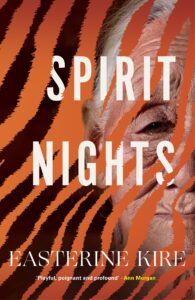
“I harvested community memory of the Naga tribes in their remote village homes to gather the tales that fuel this novel. These stories reflect their spiritual world and while some might think of the stories as fantasy or magical, for the villagers, and for me, they are our reality. From them, I have learned about trusting my own power as a woman, and how a storm of forces are at work behind the observed world of our everyday lives. In Nagaland, we live our lives in great intimacy with the spiritual world and I hope this novel helps return western readers to such a place of awe for nature.”
~ Easterine Kire on writing Spirit Nights
It’s Spring at Barbican Press and we’re gearing up for the launch of some exciting titles, starting with James Thornton’s eagerly anticipated Nature, My Teacher.
James Thornton’s latest book, the hotly anticipated and highly praised Nature, My Teacher, launches on April 16th. Ahead of this, James recently featured on KWMR’s Airwaves with host Raul Gallyot. They talked about the origins of the book and what led James to where he is today, stretching right back to his childhood memories of competing with his siblings in conversation at the dinner table. He also gave a powerful reading from the book, selecting a poignant essay that entertains, educates and invites us all to reflect on our place in this world. Don’t worry if you missed it, though—you can access the full interview as a podcast right here.
And if you’re in or near California, the Village Well in Culver City will be hosting a launch event on April 17th. James will be in conversation with our own Martin Goodman. It’s a free event, and James will be signing copies of the book, which you can buy when you arrive. If you can’t make it, the book is still available to pre-order from Amazon.
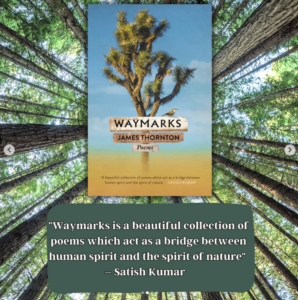
We were also thrilled to see one of James’s other titles, his poetry collection Waymarks featured by Ingram Publishing Services International in celebration of National Poetry Month.
Stay tuned for more book news soon, and happy reading!
Who was Angelica Kauffman?
As her life and work is set to be featured in two major exhibitions this year at the Royal Academy and Tate Britain, Miranda Miller provides a backdrop to this ‘paintress of minds’ at the centre of her 2020 novel.
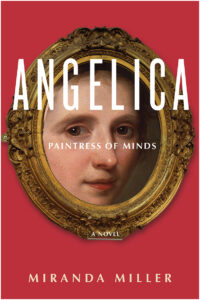
This is the cover of my eighth novel, Angelica, Paintress of Minds, which is published by Barbican Press in the UK and the US and is also available on kindle. I’m delighted to see that Angelica Kauffman is finally getting the recognition she deserves: there will be an exhibition of her work at the Royal Academy in London from March 1 until June 30 and her work will also be included in an exciting exhibition coming to Tate Britain on May 16 called “Now You See Us: Women Artists in Britain 1520 – 1920”.
I first discovered her work a few years ago when I had the good fortune to be awarded a Royal Literary Fund Fellowship at the Courtauld Institute, then housed in Somerset House. I became fascinated by the history of the building itself and by the story of the foundation of the Royal Academy there in 1768. I became so interested in her life that I knew I had to write a novel about her.
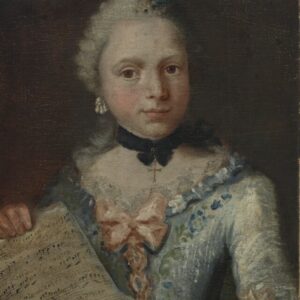
Angelica’s mother was Swiss and her father, an unsuccessful painter, was Austrian. She grew up in her father’s studio and he soon realised that she was immensely talented. He used to ask her not to sign her paintings and would pass them off as his own. Other successful painters, including Artemisia Gentileschi and Élisabeth Vigée Le Brun, were also the daughters of painters; without such a background it was very difficult for women to acquire an artistic education. Angelica was a prodigy, as can be seen from this self-portrait she did when she was thirteen.
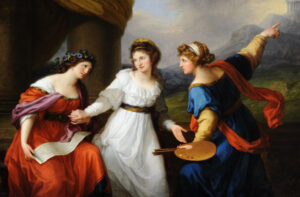
In addition to being a talented artist Angelica had a beautiful singing voice. All her life she performed as a good amateur singer and played the harpsichord. The great classical scholar Winckelmann said of her, “she sings with our best virtuosi.” This painting dramatizes the decision she had to make in her youth to choose between painting and singing.
After establishing herself as a painter in Italy Angelica came to London in 1766, when she was twenty-five. She became so successful that a word was coined, Angelicamad. She painted Queen Charlotte and other members of the royal family, and her work was reproduced in engravings, as cameos by Wedgwood, on teapots and on Worcester, Meissen and Derby porcelain. The new invention of transfer printing made these items much cheaper and she gained an international reputation. Her popularity had a price; male artists could do as they liked but ‘paintresses’ always had to be decorous or risk losing their aristocratic patrons. Angelica was under enormous pressure to behave as ‘Miss Angel,’ the affectionate name her friend Joshua Reynolds gave her. Astonishingly, she was so well liked and respected that she survived the potential scandal of her first bigamous marriage to a fake Count. 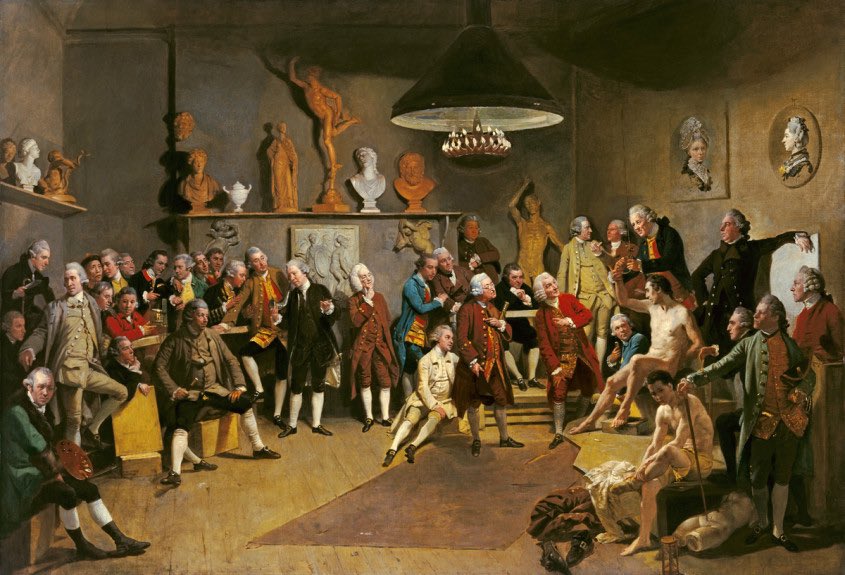
I stared at this painting by Zoffany of the life drawing class in Old Somerset House and was intrigued to see that portraits of Angelica Kauffman and Mary Moser, the botanical painter, were on the wall, staring down at the proceedings like ancestors. Although they were both alive and founder members of the Royal Academy, as women they were not allowed to attend life drawing classes there because respectable ladies were not supposed to look at a naked man.
After fifteen triumphant and lucrative years in London, Angelica was terrified (as a Catholic) by the Gordon Riots and she decided to return to Italy with her second husband, Zucchi, a Venetian artist. Angelica spent her last twenty-five years in Rome, a city where I lived in my twenties and which I love. In my novel Angelica, as an old lady, is living in her house at the top of the Spanish steps.
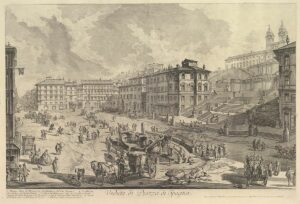
As she looks back on her life, she is afraid of the new century which is destroying the world she knew and finds herself isolated because her husband and most of her friends have died or left Rome. She has a valuable art collection and expects the soldiers of Napoleon, who she detests, to arrive at any minute and loot it.
In her studio, Angelica stares at her self-portraits and relives her journey from a poor background to international fame. She draws us into her fascinating past through her self-portraits and the portraits she has painted of her friends, including Antonio Canova, Germaine de Stael, Emma Hamilton and Goethe. This is a novel about a gifted and powerful woman with a kind heart. Like us, she lives at a time of bewildering change and fears the unknown future.
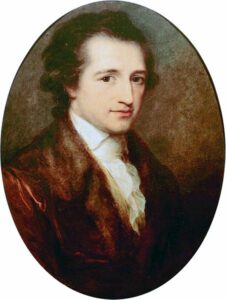
My interest developed into a passionate engagement with Angelica and the many interesting people she painted and befriended. Every time I encountered a new name – Reynolds, Canova, Goethe, Madame de Stael, Emma Hamilton and many more – I had to stop writing my novel and read a book, or several books, about them. Thanks to a generous grant from the Authors’ Foundation, I was able to return to Rome and also to visit Weimar to learn more about Goethe, with whom I believe she was unrequitedly in love. This is the portrait she did of him, which he disliked because he didn’t think it made him look heroic enough.
In order to make a successful career as an artist Angelica had to battle against powerful waves of misogyny. Those battles are still being fought; it was not until 1936 that another woman, Laura Knight, was elected as an RA. Finally, generations of talented women artists are beginning to be recognised. This is the right moment to rediscover Angelica Kauffman’s life and work.
Learn more about Angelica, Paintress of Minds and grab a copy now.
Martin Goodman’s Ectopia, originally published in 2013, has been republished as an audiobook that’s available on Spotify! It’s now massively accessible with powerful, dramatic narration that enriches already brilliant source material. Listen to the greatness in just a click – right here.
Pru, how are you? Introduce yourself!
Coming out of a post graduate degree in an uncertain industry has certainly been a little stressful but the determination I had during this production still remains the same. I’m a 23-year-old Northerner looking for ways to have the adventure of a lifetime doing great things!
Describe Ectopia to us in your words:
Ectopia is a reflection of what the world could come to in under 300 pages. Homophobia, hate crimes, sexual violence and nasty experiments. It also manages to pull through with an escapist romance in a post-apocalyptic world where science struggles to define humanity.
How does Ectopia benefit from an audiobook?
Ectopia is a very vocal, visceral book. Originally a movie idea, as I recall Martin saying. It makes sense to hear the emotions and feel what the characters are going through. It really makes you curl your toes and leaves you with a gaping mouth.
What’s a particular (spoiler free!) moment that benefited from being adapted into an audiobook and why?
There are many… ones that make you gag, and smirk and ones that shock you unexpectedly. In some ways, Ectopia reflects the unexpected reality of our present. The brother and father’s volatile relationship leads to a dramatic change in the book. I think that’s the moment that best benefited from being audio.
Could you tell us about the actors involved?
Emma and Dan brought everything an actor should especially with their own individual talents. Emma’s ability to bring such a natural delivery with the smaller part of Karen was great to record on the final day. She was really easy to get along with and communicate with which made my job easier. I’m glad I could give her a relaxing environment too.
Dan’s versatility and ability to evoke heavy emotions was stunning and I loved watching him from behind the studio. He was juggling both rehearsals for his showcase and this long production of Ectopia – so kudos to him!
How did working on Ectopia come about, and what drew you to the project?
This project was a key part of my MA Publishing Dissertation at Manchester Metropolitan University. There were editorial options and things relating to social media, but the fact there was an option to produce a full audiobook struck my eyes. I love production and it is a growing industry… I knew I would get the most out of it as well as get leadership and team working opportunities.
What was working on the project like and what was the process?
It was fun and exciting as I was bringing it all together and overseeing the flow of it which was satisfying. Like any other production, there was a lot of planning. Meetings with Martin on Zoom, talking about what we feel will do the book justice and how we can make it happen.
Being a student and a former user of a studio during my Bachelors, I contacted Raz our engineer immediately and was able to get the studio booked. From then it was a matter of auditions over a dozen actors from the North, all so amazing that I could actually give them feedback and keep them in my books!
Emma wasn’t needed until the end but we had our own little meetings. For me, Martin and Dan, we were able to meet for lunch and have a tour of the studio and begin production for 3 long days the day after.
Wrap up was kind of emotional but very relieving. I just wanted to sleep by then! It was making notes for the dissertation and keeping the social energy constant that tired me out the most… as well as the early mornings!
Dan had to shoot off to his showcase but we all got a nice picture together in the studio and then the rest of us went out for drinks… from then it was a matter of still checking up on the edits and proofs.
What was your favourite part of the project?
My favourite part must have been the auditions and letting the two know they got the part… its always those moments that get you excited for it all.
What was the most surprising part of the project?
Can’t really say… I wasn’t surprised we went over studio time and I wasn’t surprised it was a stressful process when things didn’t work out. It’s all a part of production and it was a matter of being calm and persistent.
What advice do you have for anyone looking to do audiobook production at a small publishing company?
Be ready to make things happen on your own. Unlike big publishing houses where money and space is more available, you have to make do with what you’ve got. More importantly, you can’t always guarantee yourself another gig so it’s always good to keep looking for other projects or even pitching your own to the publishing house!


