An 'impressive portfolio of beautifully crafted and utterly transgressive fiction' – The Morning Star. Now publishing simultaneously in the USA / Canada and UK
Lockdown 2020 and the view from my writing table in Lowestoft was of the North Sea. Winds blew. I was going nowhere. Here was my chance to follow Herman Melville out across the ocean.
Ishmael, the narrator of Melville’s Moby-Dick, takes us into the bed he shares with the Pacific islander Queequeg: ‘He pressed his forehead against mine, clasped me round the waist, and said that henceforth we were married.’ There’s no such ardent coupling in Melville’s novella Billy Budd, but a vast amount of male yearning. Before settling down into marriage and writing, Melville spent early years as a sailor. Was he bisexual? ‘Almost certainly,’ says the writer Robert McCrum. ‘As he himself put it: “Deep, deep, and still deep and deeper must we go, if we would find out the heart of a man…”’
Billy Budd is a sailor whose golden youth cheers the hearts of almost all his shipmates. For those of you who don’t yet know this tale of male conflict and desire on a late 18th century man-of-war, I won’t spoil it here. What I will explain is how, when you do read Melville’s Billy Budd, you’ll discover a gap in the narrative that forms the most intriguing missing book chapter in American literature. In the climactic scene from which the tale’s final drama unfolds, Captain Vere, the ship’s captain, is locked into a small stateroom with Billy. The book’s narrator, however, is locked out. The reader is left with speculation about all that happened inside. ‘Billy Budd: Captain Vere’s Account’ tells a complete and complementary, stand-alone story that takes readers into the stateroom for that meeting between the captain and the sailor. I needed to know what happened. Now I do. So can you.
My short fiction is probably the gayest thing about me. Stripped of a novel’s bulk, a story is a more naked and vulnerable form. For me, being gay was a slow blossoming. Gimlet-eyed society was taking note and set to judge (my sexuality was deemed to be criminal when I was growing up) while I was simply busy making friends, loving my dog, growing into shape, discovering the power of words, encountering technology and the natural world and the moral disquiet of adult behaviour. For its characters, novels are something of an endurance task and a question of survival. They face what the world throws at them and strive to come out the other side. The sheer heft of a novel needs its characters to be strong, so as to carry all that narrative weight. In a story they can dare to be themselves. My short fiction explores gay nature with its shields down.
Native American societies have the culture of the ‘berdache’. Over recent decades that French term has gathered colonial shades, and within those societies the term ‘tw0-spirit’ has currency though with a somewhat different meaning. The story as I learned it, in simple form, was that a baby boy was laid down between a bow and arrow on one side and a doll on the other. If he turned toward the doll, then he was judged to be gay: and the family celebrated. They needed no more children because their family was now perfect and complete. Their gay child would be a huge boon to their society.
My own culture knew no such concept of celebration of gayness, only the opposite of shame, so I borrowed it. The theme is played out through ‘The Lovely Life of Arnold’, a sequence of stories that runs throughout the collection. They follow Arnold in seven-year leaps – adopting the concept of the TV series Seven-Up that followed children of my age and time but featured none that were gay.
Most stories have been published in journals and magazines and go back years. ‘Letters to the Parishioners’ drew on overland journeys I took through Greece, Turkey and Cyprus in the footsteps of St Paul. It’s a late twentieth century tale, from when I could maintain some interest in the Anglican church.
You finish a novel, but characters live beyond the novel’s scope. In ‘Queenie and the Boy’ you’ll meet Tom, who has stepped out of the closing pages of my upcoming novel The Boy on the Train. It’s the other of my pandemic tales, pulled into my imagination as I stared out at the North Sea.
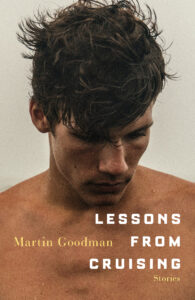 My collection is called Lessons from Cruising – (the title story comes from lessons learned from recognizing youth is something separate to yourself, on a boat trip off Plymouth. Water is another theme that links the stories.) Please enjoy the journey through its pages.
Key to the small publishing house I run, Barbican Press, is sharing my private reading passions. ‘This book is so special EVERYONE should read it.’
That approach takes a new turn this month – our newly released book is old and the writer is long since dead.
I came across it in the rare books room of the British Library, a tangential find while researching treatment for Canadians wounded in World War I.
The book is Letters from the Little Blue Room and its author was anonymous. Its accession stamp says January 1917. The writer’s direct and appealing voice struck me at once. These are letters from a Scottish woman to her younger brother, who emigrated to Scotland and is returning to fight in the Great War. The first letter is dated August 2nd, 1914, weeks before war is declared, addressed to Dear Boy:
I came very near to heading this letter “Slough of Despond” instead of “Blue Room”. Why? Because, look you, we are back in town again, after one of the most glorious holidays we have ever spent in any summer …
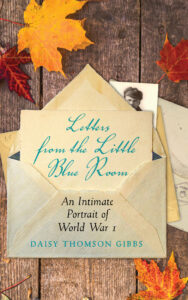 A sister is writing to her brother, but in a way that speaks directly to any reader. The town she is writing from (anonymous in the book) is Dunfermline, which as home to the Black Watch regiment was pivotal to the war. The letters bring a gradual unveiling of that war in an account that is personal, touching, and often funny as she works to keep up her brother’s spirits. It is a wonderfully revealing account of life on the home front and the wartime role played by women.
That reading room experience came fourteen years ago. The book’s dedication gives the military numbers and regiments to her two brothers. From those I discovered a brother’s namesand an address, the home of the ‘little blue room’ from which the letters came, and so the name of their writer.
She was christened Margaret Thomson. Her family called her Daisy, and she later took the married name of Gigg – in bringing her story out of anonymity I am publishing it as by Daisy Thomson Gigg. Pursuing details on ancestry.co.uk showed someone else actively researching the family: a man who is the grandson of ‘Boy’, the brother. I then corresponded with other grandchildren, including Daisy’s granddaughter, to discover the true family backstory that underpins the tale.
The book becomes extremely moving – I sat tearful when first completing it.
I found my own copy and had it scanned. Next step was cleaning the text. The family story that underpins the book and reaches beyond the book’s timeframe is equally dramatic and affecting to the one the book recounts. Family photographs add their own power to the book, and I raided eBay for period photographs of Dunfermline and the Winnipeg Rifles. 108 endnotes explain and develop some of Daisy’s refences. My closing biography tells Daisy’s family story, while Angela Smith’s foreword sets the book in its literary context: “Compelling. A new and unique voice and an important addition to the canon of literature of the First World War.”
Daisy was a suffragette and a pacifist but moves beyond both those admirable qualities because she is a writer: she gives us the human condition.
The book is a literary gem, it rediscovers a major Scottish (and Scottish-American) writer, and as our world shifts back toward states of war it couldn’t be more relevant.
I’ve made it available. Now I hope readers find it and tell their friends. Please do!
The stories in Martin Goodman’s new collection Lessons from Cruising come from across the globe, a couple stemming from Covid and the year of lockdown. ‘We locked ourselves away in Britain’s most easterly point, and different aspects of Lowestoft life sparked a pandemic story. Things like the kittiwakes nesting on the window ledge of a top floor apartment. The queue of people socially distanced outside Iceland. The men from the council appearing in full isolation gear to strip old asbestos from allotments. The story ‘Queenie and the Boy’ is about an unlikely friendship between a haggard old woman and a lone teenage boy.’
Stories are set in different coastal spots in England as well as India, Turkey and the United States, but generally, they start from time staring out of the window. ‘A lot of a writer’s time is spent staring out the window. The Suffolk Coast is perfect for that – look out over the sea and it’s a huge and changing blank canvas. And when you’ve stared through the window long enough you take a walk. Stuff is happening in your head. I’ll walk the beach toward Kessingland and coming back, approaching the pier, is where ideas for a story tend to fall into place.’
‘Benjamin Britten grew up in Lowestoft with the same sea view. It must have helped him write his opera Billy Budd, taken from Herman Melville’s classic novel

Benjamin Britten’s House in Lowestoft
about a handsome sailor. There’s a chapter missing in the novel, and in the opera too, where the ship’s captain tells Billy Budd he is to be hanged. I wanted to know what happened in that missing scene. So I read and re-read the book, stared out at the sea and its horizon that was filled with tankers waiting to dock at Felixstowe, and then rewrote it from the captain’s point of view. We have the entire story, ‘Billy Budd: Captain Vere’s Account’, which complements Melville’s original while adding those elements he missed.’
All the stories in the collection are gay themed. Are there more in the works?
‘I’ve a big nonfiction book My Head for a Tree about India coming out next year. Short stories are more intimate things. Sometimes they are a way of finding answers to what puzzles you. This collection is my way of quietly exploring who I am.’
October 2022 and James Thornton was spun away from seventeen years of frontline action, setting up the global environmental law charity ClientEarth. He had six months of sabbatical before a regular working life resumed, no longer the group’s CEO but its president and founder.
We found quiet places in Nature where James could reflect and recover – in the Western Cape region of South Africa, and then in Baja Sur, the Mexican state that runs as a long peninsula down the Pacific Coast. James hung out with birthing whales, and walked among flowers and birds.
And he wrote. Of late his poetry had become prose poetry. How different is that to an essay? Not much. You can refashion such work into the essay form. And perhaps readers are more open to essays.
And so prose poems were reworked into short essays, and new essays flowed behind. James was responding to the natural world, and his writing was in conversation with it.
Along the way, more publishing decisions were made. James’s Zen master once told him that Nature was his teacher. For years James had been acting as the lawyer to the Earth. What does that mean, to represent nature and take lessons from it? What might you learn?
The book became an open enquiry. Freed from the daily rush of fighting for the planet’s existence, James was able to face up to his own climate anxiety. How does it show itself, how do you cope with it, how do you continue the fight, how might you deal with it? In answering these questions, the book took on another dimension. Humans are not separate from the natural world, so this book about nature also became a study of human consciousness.
Buddhist poets are referenced, but you’ll find no overtly Buddhist language in the book – another publishing decision had been made.
And Nature, My Teacher started to find its own structure, fitting into twelve separate ‘books’, each concluding with a poem and a photograph.
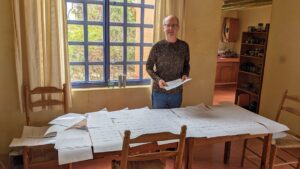
You’ll see the structure taking place in this photo, James with the pages of his manuscript arrayed across a Mexican table. And a smile on his face.
It went out to readers. They reported being moved to tears. Good tears. Something was working. And their corrections and suggestions were folded in. The book gathered blurbs, from a range of good people who could help the book reach audiences in the USA and the UK, and in Zen and non-Zen circles. Arianna Huffington, for example, does not blurb lightly and always reads what she promotes. Her praise is touching and effusive.
Paperback or hardback? It feels like a book readers might want to carry with them and consult, and keep turning the pages. So a tidy sized hardback. And at an affordable price so everyone can read it.
Bamboo leaves were the initial go-to cover image. Decoratively it was fine, but this book promotes a journey. Light filtered through a forest aims to draw readers in.
Barbican Press has a major campaign going to promote the book, run by an agency in Los Angeles, and separate in-house outreach from the UK. James is airing the book in launches, podcasts, interviews, festival appearances. Still, it’s going to need word of mouth. The next step for the book is for people to love it and share the love.
That, of course, is the bottom line with every book.
___
Martin Goodman will be in conversation with James for the launch of Nature, My Teacher in the Village Well bookstore, Culver City, April 17th. And for those in Europe, flock to Watkins Bookstore on July 18th for the London launch!
“Given the 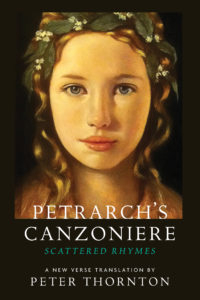 impossibility of reproducing Petrarch’s verbal music in English,” writes Peter Thornton in his introduction to Petrach’s Canzoniere, “I decided that my goal was not to convey the matter of Petrarch’s sonnets and canzoni in adequately carpentered English that closely followed his grammar, let alone his difficult Italian syntax, which the Italian commentators not infrequently feel they need to explain to Italian readers. My goal was rather to create modern English poems that made Petrarch present to a contemporary Anglophone reader, conveying emotional impact on their own, singing and weeping believably in the idiom of our day, the verses pulsing with a life of their own, so that to some extent the poems would constitute independent creations.”
As an occasional treat, we will be posting some of Peter’s exquisite translations of Petrarchan sonnets here. Here’s the poet, and his love for Laura:
218 Tra quantunque leggiadre donne et belle
Among whichever beauties she appears,
the one who has no peer from east to west,
the beauty of her face does to the rest
what morning does to all the lesser stars.
Love seems to me to whisper in my ear,
saying, “As long as she is in the world
life will be good, but later dark and cold;
virtue will die, my kingdom disappear.
“Should sun and moon be taken from the skies,
the grass and leaves from earth, the winds from air
and from man his intelligence and speech,
“the sea denuded of its waves and fish:
so will the world be desolate and more,
should Death forever close and veil her eyes.”
Martin Goodman ponders questions posed by the decisions taken in filming The Zone of Interest, compared to those he faced when writing his own related The Cellist of Dachau. Both go inside the homes of Nazi families, who live beside concentration camps. One chooses not to portray the horrors…
Visiting Auschwitz, it’s striking to see the family home of the camp Kommandant Rudolf Höss tucked against the concentration camp’s walls.
Joanathan Glazer’s new film The Zone of Interest takes you inside the walls and gardens of that recreated home. It’s a slow and steady visit, the film opening with minutes of black screen while a soundtrack of dark echoes plays against it.
The first scene is a summer pastoral, the Höss family picnicking by a river. We then follow them home. This is a fine home, a garden of flowers and vegetables lovingly tended by Frau Höss, the “Queen of Auschwitz”. It’s a good place to bring up the family, away from the stresses of the city. The horrors of Auschwitz are kept off-screen, only to be heard on the soundtrack. Distant chimneys belch smoke. Businessmen bring plans for a new construction: crematoria where the heating of furnaces in one chamber cools another, enough that human ashes can be processed.
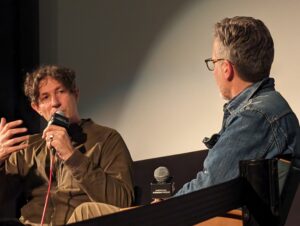
Jonathan Glazer speaking with Jonathan Lethem
The film was presented pre-release at the Aero Cinema in Santa Monica, stoking any Oscar interest among Los Angeles’ voters. Jonathan Glazer appeared in conversation with the novelist Joanathan Lethem – who first asked the director to speak of the film’s studied dullness.
There is no story, Glazer said, no drama (though there is the drama of whether the Höss family will be forced from their much-loved home). It was a film he didn’t want to make, and the cast didn’t want to appear in. His intention was to have the audience project themselves onto the ordinariness of the Höss family, and understand the simple human lives behind the mass extermination of whole peoples.
Glazer had ten hidden cameras working, but no film crew on set – scenes were relayed by cable to a distant container. He used no cinematic lighting – it was all daylight or the light from the house’s regular lamps. The Höss house was recreated for the film.
The film, in this way, was a product of the director’s sensibilities, his worry about turning cameras directly on the horrors. As scripted, Frau Höss set out ladies’ clothes for the staff to select from and chose a fur coat for herself. The audience was left to work out that these were the clothes of Jews sent to the gas chambers; that the Höss children played with gold teeth taken from murdered Jews. In conversation with friends Frau Höss joked that someone had thought her coat came from Canada the country. The Canada joke was not explained. What is the explanation? That “Canada” was the name given to the warehouses in which goods stolen from Jews about to be murdered were stored. It was a name for the inmates to use, “Canada” standing in for all that was wonderful if you could escape from the camp. I learned that “Canada” detail on a weeklong visit to Auschwitz. How many have done that? The film asks its audience to fill in the details of the Holocaust from their own knowledge.
How many have that knowledge?
In an early draft of my novel The Cellist of Dachau I too omitted details of what went on in the camps, and tried to avoid mentioning Auschwitz. There was a wish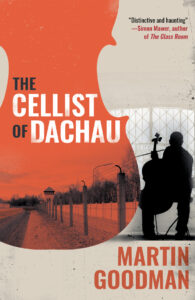 not to add to the horrors by dramatizing them. Then I realized that people no longer know those details. And even all that I knew was almost nothing when set aside what went on, when I looked more closely. So I told what happened at Dachau, at Buchenwald, at Theresienstadt, and at Auschwitz.
A link between novel and film is that I also focused on a Nazi family – in this case the Adjutant at Dachau and his pregnant wife. I spent time inside the camp at Dachau, but also examined the quarters outside, picking a home for the Adjutant. The fusion of human elements with Nazi monstrosity fueled The Cellist of Dachau which sought some response to the question “How can the Nazis have loved the music of J.S.Bach and Schubert while committing genocide?”
Another curious link – both the novel and film included the present site’s women cleaners. In the film, they are cleaning the display cases in which items such as mounds of shoes stolen from Jews, their luggage, their walking aids, are on show. In my novel I used a scene that struck me on my visit: men with machines cutting plants in the forest, while women in electric carts dusted information signs. There’s some link between men and the mechanization of slaughter.
The Zone of Interest is a worthy and honest film, doing its best to express “the banality of evil”. But it needn’t set a trend, for not many of us have the details to fill in what we hear on the soundtrack. The film is set in 1943. It’s recent, yet pre-history for some of today’s young. We can’t presume its horrors are known, or that any lessons have been learned.
We then follow them home. This is a fine home, a garden of flowers and vegetables lovingly tended by Frau Höss, the “Queen of Auschwitz”. It’s a good place to bring up the family, away from the stresses of the city. The horrors of Auschwitz are kept off-screen, only to be heard on the soundtrack. Distant chimneys belch smoke. Businessmen bring plans for a new construction: crematoria where the heating of furnaces in one chamber cools another, enough that human ashes can be processed.
The film was presented pre-release at the Aero Cinema in Santa Monica, stoking any Oscar interest among Los Angeles’ voters. Jonathan Glazer appeared in conversation with the novelist Joanathan Lethem – who first asked the director to speak of the film’s studied dullness.
There is no story, Glazer said, no drama (though there is the drama of whether the Höss family will be forced from their much-loved home). It was a film he didn’t want to make, and the cast didn’t want to appear in. His intention was to have the audience project themselves onto the ordinariness of the Höss family, and understand the simple human lives behind the mass extermination of whole peoples.
Glazer had ten hidden cameras working, but no film crew on set – scenes were relayed by cable to a distant container. He used no cinematic lighting – it was all daylight or the light from the house’s regular lamps. The Höss house was recreated for the film.
The film, in this way, was a product of the director’s sensibilities, his worry about turning cameras directly on the horrors. As scripted, Frau Höss set out ladies’ clothes for the staff to select from and chose a fur coat for herself. The audience was left to work out that these were the clothes of Jews sent to the gas chambers; that the Höss children played with gold teeth taken from murdered Jews. In conversation with friends Frau Höss joked that someone had thought her coat came from Canada the country. The Canada joke was not explained. What is the explanation? That “Canada” was the name given to the warehouses in which goods stolen from Jews about to be murdered were stored. It was a name for the inmates to use, “Canada” standing in for all that was wonderful if you could escape from the camp. I learned that “Canada” detail on a weeklong visit to Auschwitz. How many have done that? The film asks its audience to fill in the details of the Holocaust from their own knowledge.
How many have that knowledge?
In an early draft of my novel The Cellist of Dachau I too omitted details of what went on in the camps, and tried to avoid mentioning Auschwitz. There was a wish not to add to the horrors by dramatizing them. Then I realized that people no longer know those details. And even all that I knew was almost nothing when set aside what went on, when I looked more closely. So I told what happened at Dachau, at Buchenwald, at Theresienstadt, and at Auschwitz.
A link between novel and film is that I also focused on a Nazi family – in this case the Adjutant at Dachau and his pregnant wife. I spent time inside the camp at Dachau, but also examined the quarters outside, picking a home for the Adjutant. The fusion of human elements with Nazi monstrosity fueled The Cellist of Dachau which sought some response to the question “How can the Nazis have loved the music of J.S.Bach and Schubert while committing genocide?”
Another curious link – both the novel and film included the present site’s women cleaners. In the film, they are cleaning the display cases in which items such as mounds of shoes stolen from Jews, their luggage, their walking aids, are on show. In my novel I used a scene that struck me on my visit: men with machines cutting plants in the forest, while women in electric carts dusted information signs. There’s some link between men and the mechanization of slaughter.
The Zone of Interest is a worthy and honest film, doing its best to express “the banality of evil”. But it needn’t set a trend, for not many of us have the details to fill in what we hear on the soundtrack. The film is set in 1943. It’s recent, yet pre-history for some of today’s young. We can’t presume its horrors are known, or that any lessons have been learned.
A telling broadcast from the future: Martin Vopenka introduces a stark vision of where our world is heading. For the full story: Barbican Press | My Brother the Messiah

Some words of praise from Hilary Mantel grace the cover of Miranda Miller’s novel Angelica: Paintress of Minds: ‘‘Miller’s intricate fictions are lit by the dark flicker of a strong and original imagination.’
These were words, of course, from a writer who knew; who had such an original imagination.
Miranda writes here of her friendship with Hilary, and gives us insights from their correspondence: Please take time to read it. How My Friend Hilary Mantel Got Inside People’s Minds ‹ Literary Hub (lithub.com)
And here are some extra lines from Miranda, not in that LitHub posting:
“She never forgot how it felt to be powerless and gave generous emotional support to many other people as well. When she was 27, she had to have a hysterectomy so she couldn’t have children but I think she enjoyed their company. She was very kind to my daughter Rebecca and always wanted to hear about my grandsons. In an interview with La Repubblica in 2021 she said, “I wish I had grandchildren.” It must have taken enormous courage to fight through her illness to write those wonderful books and make public appearances.”
Miranda recommends Hilary’s ninth novel, Beyond Black, as “the one that brings together her unique gift for comedy, her sympathy for outsiders and her perception of the unheimlich.” That ‘unheimlich’ element includes a strong sense of the dead still being with us, an element that slips into Hilary’s autobiography too. The literary world is dimmed without her, but she has left us some splendid adventures, and may yet be enjoying fresh adventures of her own. We thank her, wish her rest, and possible fun.

A Q&A with Colin W. Sargent, author of RED HANDS…
Born in Serbia Tomislav Longinovic, PhD, is a world expert in Slavic folklore and imagery. His works include Vampire Nation: Violence as Cultural Imaginary and Vampires Like Us. He’s taught at the Iowa Writers Workshop, at Harvard, and is emeritus professor of Slavic, Comparative Literature, and Visual Culture at University of Wisconsin-Madison.
Reading the novel Red Hands, which tells the story of Communist Romania through the eyes of Iordana Ceausescu, the dictator’s daughter-in-law, brought back memories of Tomislav’s youth in what was then Communist Yugoslavia. ‘We had relatives who came to live with us in Belgrade from Romania during those worst years of heat and food restrictions,’ he recalls.
Tomislav was happy to meet up with Red Hands author Colin W. Sargent to discuss his responses to the book, two contrasting communist regimes… and seagulls!
TL: From where I am right now, I’m looking across the Danube to Romania. I told some friends I’d be talking to you. One said, “Romanian smugglers would drop goods right here in the Danube. Old scrap metal.” He pointed to the shore. “Even now, it’s full of scrap metal at the bottom that wasn’t picked up. The Romanian ships would drop, Serbian ships pick up.” There was also a contraband business in oil.
CS: Something’s always going on behind the scenes.
TL: That’s very resonant in Red Hands. Of course, to Romanians, Yugoslavia was a Western country, a haven. My family had Romanian relatives across the river. When they were cold and hungry, two or three came here to take refuge with my father during the final years of the Ceausescu regime. So it’s all very close to me. 
CS: I’m hoping Red Hands connects with your Vampire Nation, the way the West has unconsciously or consciously tried to submerge Balkan countries with blood and vampire imagery. Even the Romanians couldn’t resist. During the Romanian revolution, crowds put up “Death to the Dracu Grandson” posters on subway walls in Bucharest while Iordana and her son were fleeing the city.
TS: That’s a really, really good connection [which makes Iordana’s sneaker fascination for the West, along with other young members of the Nomenclatura, more complex]. I really liked reading that part.
CS: I laughed at the idea that playing bridge was forbidden by the Ceausescus, because it brought intellectuals together. Was that the case in Yugoslavia?
TS: No, not on that level at all. The main terror was in 1945 to 1948, and then when Tito broke with Stalin, things began to stabilize. Tito was tracking a middle course, getting western loans. We were comparatively lucky. None of my family was part of the communist movement. I always felt a private life at home, at the dinner table, in the 1950s to the middle 1960s. I found the same thing in the private moments of Iordana’s life–they’re described quite well in Red Hands. My father would always say, “Never say that in school!” Then we’d listen to the BBC and Radio Free Europe at night.
CS: What was the impact of the movie Dr. Zhivago on Eastern Bloc countries?
TS: It was bigger in Yugoslavia than in the rest of the Soviet bloc. We already had movies like that, our own Black Wave in films, critiquing the government. It got funny. Movie production companies created one edit was for film festivals outside the country, one inside the country or they would never be shown.
CS: Was godlessness in fashion in your Yugoslavia?
TS: Not really, not to that extent. My family was Orthodox Christian.
CS: Iordana is privileged, and like all of us she ducks in and out of self-knowledge. From your position just across the river, do you think of her as a character who’s strong, weak, or how would you describe her?
TS: I would say very strong. Everything she had to go through. She’s part of the Nomenclatura but sort of drops off, which makes her more interesting. It made me remember that I refused three times to join the communist party: at the end of high school, during University years, in the Yugoslav army [compulsory], which was a little hard to pull off. To stand up and say you have no interest in that. But to me the army wasn’t fighting about the fate of the nation, but only for communism, which weakened the whole idea.
CS: Romanians were nicknamed the polenta people, flexing to any attack but somehow surviving. I can see a parallel to Italy, but is there a parallel to Yugoslavia?
TS: The Romanian word for it is mamaliga. It’s a delicious dish, by the way. We were always brought up with the sense that we were the in-between country; that we were part of the east and west, being able to connect both.
CS Iordana and I were connected by our each having a son. But more like the ‘raindrops that touch us all at once, uniting us,’ we were also connected by our love for seagulls. You love the coast. You must know some gulls by name. What’s your take on seagulls?
TS: That’s a good question for me, because their number since I was a kid has been steadily and rapidly increasing. I used to draw them in flight. They’re a menace now, beautiful from a distance but frightening up close. There’s a city in Croatia where kids can’t be taken outside; the gulls will steal their lunches. More recently, when alone in nature, like during yoga, I can almost feel like I can talk to them. You know, I call them over.
Drawn from eighty hours of unique interviews and told in Iordana’s own voice; RED HANDS is a true-life tale that spins readers into the pleasures, excesses and horrors of late twentieth-century Europe. Learn more here.
 D.D. Johnston’s Disnaeland is a rare beast of a novel: it takes the stuff of the apocalypse and makes you laugh. Dystopian stories, like Cormac McCarthy’s The Road, lead readers into ever-darkening times. Disnaeland starts with the premise that life on earth is already pretty shitty: when the crisis comes, when the world’s power supplies cut off, what happens next? Here’s D.D.’s take: ‘The disaster in Disnaeland spurs the people of Dundule to grow and heal, find love and friendship, and briefly create something like Heaven on earth.’ So that’s our first pick of books from writers who find light in dark times. We asked D.D. Johnston to pick four others to which he feels close..
- Station Eleven by Emily St John Mandel. Although published back in 2014, this Canadian pandemic novel’s having a new lease of life with a TV version currently screening. It’s unusual – and similar to Disnaeland – in that it focuses on the decency and humanity of survivors of the apocalypse rather than on their barbarism (it’s also really quite good!).
- The Sunlight Pilgrims by Jenni Fagan. Again, this is a bit older (2016) but it’s a somewhat hopeful and tender (and fantastical) Scottish take on the edge of the world.

- How To Survive Everything (When There’s No One Left To Trust) by Ewan Morrison (2021). This is probably the closest – a Scottish novel narrated by a teenage girl whose survivalist dad is obsessed with a coming pandemic. Even features a gruesome amputation scene.

- I’d also mention Rebecca Solnit’s non-fiction A Paradise Built In Hell: The Extraordinary Communities That Arise In Disaster (2010). It’s about how real-life disasters bring out the best in us: real-world public responses to disaster are characterised by “altruism, resourcefulness, and generosity”.